01The four rites
The four rites of Umrah
Umrah takes about three to four hours. Here is what each step involves.
Step 1
Ihram
Before the Miqat, men put on two white sheets and women wear modest everyday clothes. Make the intention for Umrah and begin the Talbiyah.
إحرام
Step by step
- 1At home: trim nails, remove unwanted hair and take a full bath (ghusl).
- 2Men wear two white sheets — one wrapped round the waist, one over the body — and no garments cut to the body's shape, such as shirts, trousers or socks; stitching on the sheets or belt is not a problem. Women wear modest everyday clothes and keep cloth off the face while in Ihram; a cap or visor niqab lets you stay covered in front of men without the cloth touching the face.
- 3If it is not a disliked (makruh) time, pray two voluntary rak'ahs — recommended, not required, in the view of most scholars including the Hanafis. Then make the intention for Umrah and start reciting the Talbiyah.
- 4On a flight from Dhaka the Miqat is crossed in the air — in line with Yalamlam or Qarn al-Manazil, depending on the route. Put on Ihram before boarding and make the intention a little before the crew announces the Miqat.
- 5Going to Madinah first? Then you don't need Ihram from Dhaka: enter it at Dhul-Hulayfah (Abyar Ali), Madinah's Miqat, on the way to Makkah.
Source: Surah al-Baqarah 2:196; Sahih al-Bukhari 1524, 1542; Sahih Muslim 1181
Step 2
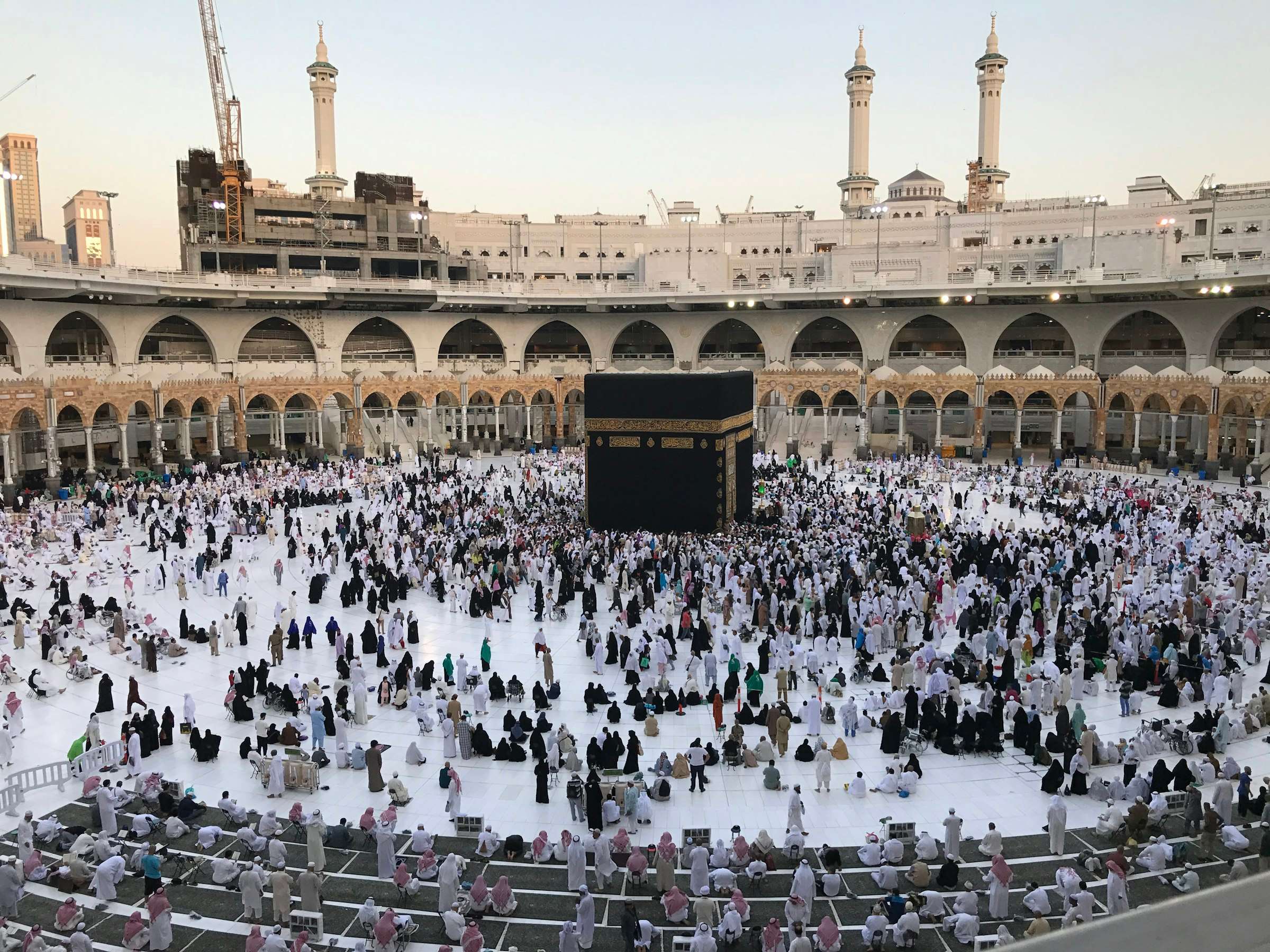
Tawaf
Seven circuits of the Kaaba, starting from the Black Stone, then two rak'ahs behind Maqam Ibrahim and a drink of Zamzam.
طواف
Step by step
- 1Be in wudu for Tawaf.
- 2Men uncover the right shoulder (Idtiba) for this Tawaf.
- 3Stand in line with the Black Stone, gesture towards it with your hand (Istilam) and say “Bismillahi wallahu Akbar”; stop the Talbiyah now. At the start of every circuit, point again and say “Allahu Akbar”.
- 4Walk seven circuits with the Kaaba on your left. Men walk briskly with short steps in the first three (Ramal).
- 5Hatim (Hijr Ismail) is part of the Kaaba, so walk outside it. A circuit that cuts through it does not count.
- 6Touch the Yemeni Corner if you can, but don't kiss it or point to it. Between the Yemeni Corner and the Black Stone, recite the dua below.
- 7After Tawaf, men cover the right shoulder again. Then pray two rak'ahs behind Maqam Ibrahim, or anywhere in the mosque if it is crowded, and drink Zamzam.
Dua between the Yemeni Corner and the Black Stone رَبَّنَا آتِنَا فِي الدُّنْيَا حَسَنَةً وَفِي الْآخِرَةِ حَسَنَةً وَقِنَا عَذَابَ النَّارِ
Rabbana atina fid-dunya hasanatan wa fil-akhirati hasanatan wa qina 'adhaban-nar.
Our Lord, give us good in this world and good in the Hereafter, and protect us from the punishment of the Fire.
Surah al-Baqarah 2:201; Sunan Abi Dawud 1892
Step 3
Sa'i
Seven laps between the hills of Safa and Marwah, starting at Safa and ending at Marwah — about 3.2 km in all.
سعي
Step by step
- 1Wudu is not required for Sa'i, but it is better to be in wudu.
- 2As you reach Safa, recite “Innas-Safa wal-Marwata min sha'a'irillah” (Surah al-Baqarah 2:158).
- 3Climb Safa, face the Kaaba and raise your hands as in dua. Say “Allahu Akbar” three times and recite the dhikr below, then make your own dua in any language. Alternate the dhikr and dua like this three times. Then walk to Marwah and do the same there (Sahih Muslim 1218; Muwatta Malik).
- 4Walk to Marwah — that is one lap. Marwah back to Safa is the second.
- 5Men jog lightly between the green lights; women walk at a normal pace.
- 6Finish at Marwah after the seventh lap.
Dhikr on Safa and Marwah, facing the Kaaba لَا إِلَهَ إِلَّا اللَّهُ وَحْدَهُ لَا شَرِيكَ لَهُ، لَهُ الْمُلْكُ وَلَهُ الْحَمْدُ، وَهُوَ عَلَى كُلِّ شَيْءٍ قَدِيرٌ، لَا إِلَهَ إِلَّا اللَّهُ وَحْدَهُ، أَنْجَزَ وَعْدَهُ، وَنَصَرَ عَبْدَهُ، وَهَزَمَ الْأَحْزَابَ وَحْدَهُ
La ilaha illallahu wahdahu la sharika lah, lahul-mulku wa lahul-hamd, wa huwa 'ala kulli shay'in qadir. La ilaha illallahu wahdah, anjaza wa'dah, wa nasara 'abdah, wa hazamal-ahzaba wahdah.
There is no god but Allah alone, with no partner. His is the dominion and His is the praise, and He has power over all things. There is no god but Allah alone; He fulfilled His promise, helped His servant and alone defeated the confederates.
Sahih Muslim 1218
Source: Surah al-Baqarah 2:158
Step 4
Halq or Taqsir
Men shave the head or trim the hair; women trim the length of a finger joint (about an inch). Your Umrah is complete and the Ihram restrictions end.
حلق / تقصير
Step by step
- 1Men: shaving the whole head (Halq) is better; trimming the hair of the whole head (Taqsir) is also valid.
- 2Women: gather the hair and cut the length of a finger joint (about an inch) from the ends.
- 3Your Umrah is complete and you can change out of Ihram.
Source: Surah al-Fath 48:27
02In Ihram
What to avoid until your Umrah is complete
Everyone
- No perfume or scented soap, shampoo or creamSource: Sahih al-Bukhari 1542
- No cutting hair or nailsSource: Surah al-Baqarah 2:196
- No huntingSource: Surah al-Ma'idah 5:95
- No marital relations (a marriage contract is permitted in the Hanafi school, forbidden in the others)Source: Surah al-Baqarah 2:197; Sahih al-Bukhari 1837; Sahih Muslim 1409
Men
- No garments cut to the body's shape (shirts, trousers, socks); no covering the head (the Hanafi school also forbids covering the face)Source: Sahih al-Bukhari 1542
- No shoes that cover the raised bone on top of the foot (Hanafi view) — wear open sandalsSource: Sahih al-Bukhari 1542
Women
- No niqab, and in the Hanafi view no cloth touching the face; a covering held away from the face, such as a cap niqab, is permittedSource: Sahih al-Bukhari 1838
- Better to avoid gloves (the hadith forbids them; the Hanafi school allows them)Source: Sahih al-Bukhari 1838
لَبَّيْكَ اللَّهُمَّ لَبَّيْكَ، لَبَّيْكَ لَا شَرِيكَ لَكَ لَبَّيْكَ، إِنَّ الْحَمْدَ وَالنِّعْمَةَ لَكَ وَالْمُلْكَ، لَا شَرِيكَ لَكَ
Labbayk Allahumma labbayk. Labbayka la sharika laka labbayk. Innal-hamda wan-ni'mata laka wal-mulk. La sharika lak.
Here I am, O Allah, here I am. Here I am, You have no partner, here I am. All praise, blessings and sovereignty are Yours. You have no partner.
Source: Sahih al-Bukhari 1549; Sahih Muslim 1184
Recite it often from the moment you enter Ihram until you begin Tawaf.
03For women
Rulings women ask about most
During menstruation
You can enter Ihram at the Miqat while menstruating: take a bath, make the intention and say the Talbiyah, but skip the two rak'ahs. Do not enter Masjid al-Haram or perform Tawaf until you are pure; then bathe and complete your Umrah with Tawaf and Sa'i. The Ihram restrictions stay in place until then.
Source: Sunan Abi Dawud 1744; Sahih al-Bukhari 305; Sahih Muslim 1211
If you are worried about timing
If your period may fall during the trip, tell us when you book so the schedule leaves room. Ask a scholar about your own situation.
Farewell Tawaf
For Umrah, a farewell Tawaf before leaving Makkah is not obligatory; many scholars call it recommended (mustahabb). It is not done during menstruation.
Mahram
The ruling: in the Hanafi school women travel with a mahram. In the Shafi'i school, Umrah is obligatory once in a lifetime, and a woman may travel with a trustworthy group of women for that obligatory Umrah only, not for a voluntary repeat Umrah. Saudi law: under the latest rules we know of, women over 18 get an Umrah visa without a mahram; we confirm the current rule when you book. Ask a scholar about your own situation.
Source: Sahih al-Bukhari 1862; Sahih Muslim 1341
04Ziyarah
Places you'll visit
A guided tour in each city, with the history of every site from your guide.
These visits are optional; they are not part of Umrah or a special Sunnah act. The exception is Masjid Quba, where praying is an established Sunnah. Climbing the mountains or touching stones and walls is not an act of worship.
Makkah
Masjid al-Haram
- Jabal al-NourThe mountain of the Cave of Hira, where the first revelation came.
- Jabal ThawrThe cave where the Prophet ﷺ and Abu Bakr (RA) sheltered during the Hijrah.
- MinaThe valley of tents where pilgrims stay during Hajj and stone the Jamarat.
- MuzdalifahThe open plain where Hajj pilgrims spend the night under the sky.
- ArafatThe plain of the Day of Arafah and Jabal al-Rahmah.
- Masjid AishaAt Tan'eem, where pilgrims enter Ihram for an additional Umrah.
Madinah
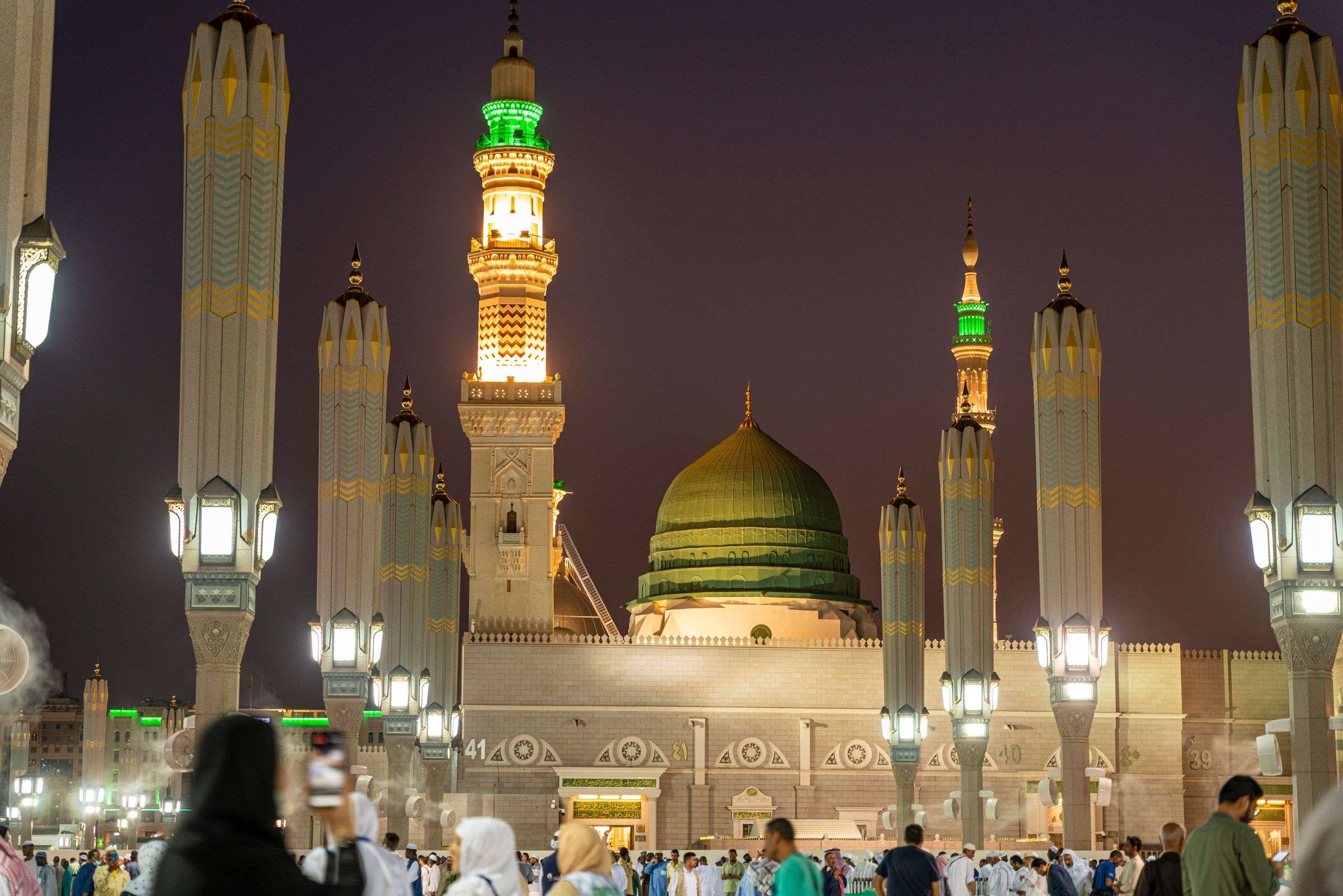
Masjid an-Nabawi
- Masjid QubaThe first mosque in Islam. Whoever makes wudu at home and prays here (for example two voluntary rak'ahs) receives the reward of an Umrah (Sunan Ibn Majah 1412).
- Mount UhudSite of the Battle of Uhud and the graves of its martyrs, including Hamzah (RA).
- Masjid al-QiblataynWhere the qiblah changed from Masjid al-Aqsa to the Kaaba.
- Jannat al-BaqiThe graveyard beside Masjid an-Nabawi, resting place of many Companions.
- Date farmsMadinah's famous Ajwa and other dates, straight from the farm.
05Before you travel
What to prepare
Send us your documents after booking and we apply for your visa. The rest goes in your suitcase.
Documents
0 of 4 ready
Packing list
0 of 8 ready
Good to know
- Currency
- Saudi riyal (SAR). To pay by card you need an international or dual-currency card, and your bank must endorse dollars on your passport before you travel; cash dollars need the endorsement too. Carry some riyals for small shops.
- Time
- Saudi Arabia is 3 hours behind Bangladesh.
- Phone
- You don't have to buy a SIM at the airport: mobile-company shops near the Haram in Madinah and Makkah have more packages, often cheaper. You need your passport and a fingerprint. For data the moment you land, buy an eSIM in Dhaka.
- Umrah permit
- Under the latest Saudi rules we know of, performing Umrah itself needs a permit in the Nusuk app; we arrange it with your visa.
- Rawdah
- Praying in the Rawdah (Riyad al-Jannah) at Masjid an-Nabawi needs a permit booked in the Nusuk app. Your guide helps you.
- Wheelchairs
- Available at Masjid al-Haram for Tawaf and Sa'i. Tell us when you book.
- Zamzam
- Airlines usually allow one 5-litre Zamzam bottle per pilgrim, bought at the airport.
Practical guides
06When to go
Umrah through the year
Umrah can be done any time except around the Hajj season, when Umrah visas pause for a few weeks. Typical daytime temperatures in Makkah:
Nov – Feb
20–30°C
Mild days, cool nights in Madinah. The most popular time outside Ramadan.
Mar – May
30–38°C
Warm and getting hotter. Usually less crowded.
Jun – Sep
40°C+
Very hot. Do Tawaf at night or early morning.
Ramadan
Varies
Umrah in Ramadan equals a Hajj in reward (Sahih al-Bukhari 1782; Sahih Muslim 1256), but it does not fulfil the obligatory Hajj. The busiest time, so book early.